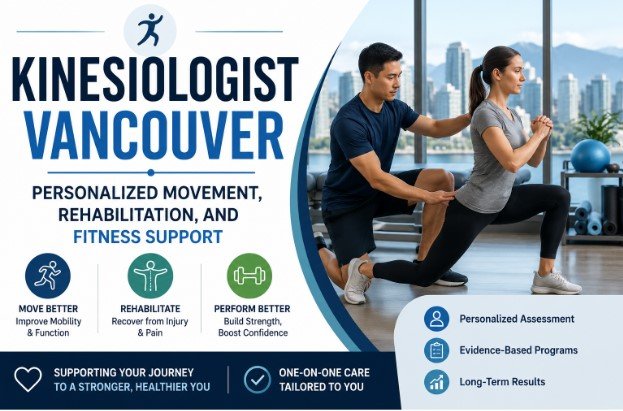
If pain, an injury, reduced mobility, or declining physical fitness is affecting your daily life, working with a kinesiologist in Vancouver may provide a structured way to improve movement and physical function. Kinesiology focuses on human movement and exercise, using individualized programs to help people build strength, improve mobility, and return to meaningful activities.
A kinesiologist can also support individuals who have completed clinical rehabilitation and want to transition into a regular fitness or performance program.
What Does a Kinesiologist Do?
A kinesiologist studies human movement and applies exercise science, biomechanics, and physical activity principles to individualized programs.
Depending on their professional training and scope of practice, a kinesiologist may work with clients on:
- Strength and conditioning
- Functional movement
- Mobility and flexibility
- Balance and coordination
- Injury recovery support
- Chronic pain management
- Postural training
- Workplace rehabilitation
- Athletic performance
Programs are generally adjusted according to the individual’s physical abilities, goals, and progress.
Who Can Benefit From Kinesiology?
Kinesiology can be appropriate for people with a wide range of goals and activity levels.
A kinesiologist in Vancouver may work with:
- Athletes
- Office workers
- Older adults
- People returning to exercise
- Individuals recovering from injuries
- People managing chronic musculoskeletal conditions
- Workers returning after an injury
- Individuals interested in improving general fitness
The appropriate program depends on the individual’s health status and objectives.
Benefits of Working With a Kinesiologist
Personalized Exercise Programs
Instead of using a generic workout routine, a kinesiologist can develop exercises around your current movement abilities, limitations, and goals.
Improved Strength
Progressive resistance exercises can help rebuild muscle strength and improve functional capacity.
Better Mobility
Mobility and flexibility exercises may help individuals improve movement and address stiffness associated with inactivity or certain musculoskeletal conditions.
Improved Balance and Coordination
Targeted exercises can develop balance, stability, and coordination, which are important for both everyday activities and athletic performance.
Support for Injury Recovery
Kinesiology-based exercise can help individuals progressively rebuild physical capacity following appropriate clinical assessment and treatment.
What Happens During a Kinesiology Assessment?
An initial assessment typically begins with a discussion about your health, activity level, and goals.
Depending on the practitioner and service, the assessment may include:
- Health and injury history
- Functional movement assessment
- Strength testing
- Mobility evaluation
- Balance testing
- Postural assessment
- Goal setting
The findings can then be used to create an individualized exercise program.
Kinesiology for Injury Rehabilitation
Recovery does not always end when an injury becomes less painful. Strength, mobility, balance, and confidence may still need to be rebuilt before returning fully to work, sport, or other activities.
A progressive kinesiology program can focus on:
- Restoring movement
- Rebuilding strength
- Improving stability
- Increasing functional capacity
- Developing conditioning
- Preparing for a return to activity
Individuals with active or complex injuries should follow appropriate guidance from qualified healthcare professionals.
Kinesiology for Athletic Performance
Kinesiologists can also work with healthy athletes who want to improve physical performance.
Training may emphasize:
- Strength
- Power
- Speed
- Agility
- Mobility
- Balance
- Conditioning
- Sport-specific movement
Programs can be adapted to the demands of different sports and individual performance goals.
Kinesiology vs. Personal Training
Although kinesiology and personal training overlap in their use of exercise, their professional roles can differ.
A personal trainer generally focuses on fitness, strength, conditioning, and exercise coaching. A kinesiologist has specialized education in human movement and exercise science and may work in rehabilitation, workplace health, or other movement-focused settings depending on their credentials and scope.
The right professional depends on your goals and whether you require general fitness support or rehabilitation-focused exercise.
How to Choose a Kinesiologist in Vancouver
When evaluating a provider, consider:
- Education and professional credentials
- Experience with your specific goals
- Experience with injury recovery
- Assessment methods
- Exercise-program design
- Communication style
- Collaboration with other healthcare professionals when appropriate
Ask about the practitioner’s qualifications and scope of practice before beginning treatment or training.
Frequently Asked Questions
What does a kinesiologist do in Vancouver?
A kinesiologist uses knowledge of human movement and exercise science to develop programs that may support strength, mobility, physical function, injury recovery, workplace rehabilitation, or athletic performance.
Can a kinesiologist help with chronic pain?
Exercise-based approaches can support physical function and may help some people manage chronic musculoskeletal pain. The appropriate program depends on the underlying condition and should be individualized.
Do I need an injury to see a kinesiologist?
No. Kinesiology can also support general fitness, mobility, injury prevention, strength development, and athletic performance.
Can a kinesiologist help after physiotherapy?
Yes. Some individuals transition from clinical rehabilitation into progressive exercise and conditioning with a kinesiologist once appropriate treatment and clearance have been provided.
Conclusion
Working with a kinesiologist in Vancouver can provide a personalized, movement-focused approach to improving strength, mobility, physical function, and performance. Whether you’re recovering from an injury, managing movement limitations, returning to exercise, or pursuing athletic goals, individualized exercise programming can help create a structured path toward better physical function.
Choosing a qualified professional with experience relevant to your goals is an important first step toward building a safe and sustainable exercise program.